


I moved to Mexico in 1992 to explore underwater caves. Meant to stay six months. Stayed twenty-seven years. The caves were the easy part.
There was a sign at the side of Highway 307. Cenote Chac Mool.
Hand-painted, on a simple old wooden board nailed to a post. The kind of sign you drive past a hundred times and don’t stop for.
The day I saw it, my husband Gary and I were coming back from a grocery run in Cancun. South of Puerto Aventuras on the jungle side of the road. The truck bed was full of dry goods, and coolers with all of the groceries iced down. We were tired. We hit the brakes and backed up to the sign. This was the Riviera Maya before it became the Riviera Maya. The dirt road led to a little cinderblock house with a thatched roof.
A short, big-bellied shirtless man in chanclas, sandals, walked out to our blue Nissan pickup. In our best Spanglish, we asked if we could see his cenote. He proudly said, “Si.” His neighbors were charging for access to their cenotes and he wanted to make some cash on his. The entry fee was ten pesos per person. A bit more than a dollar each.
We had Coca-Colas in the cooler. He took one of those too.
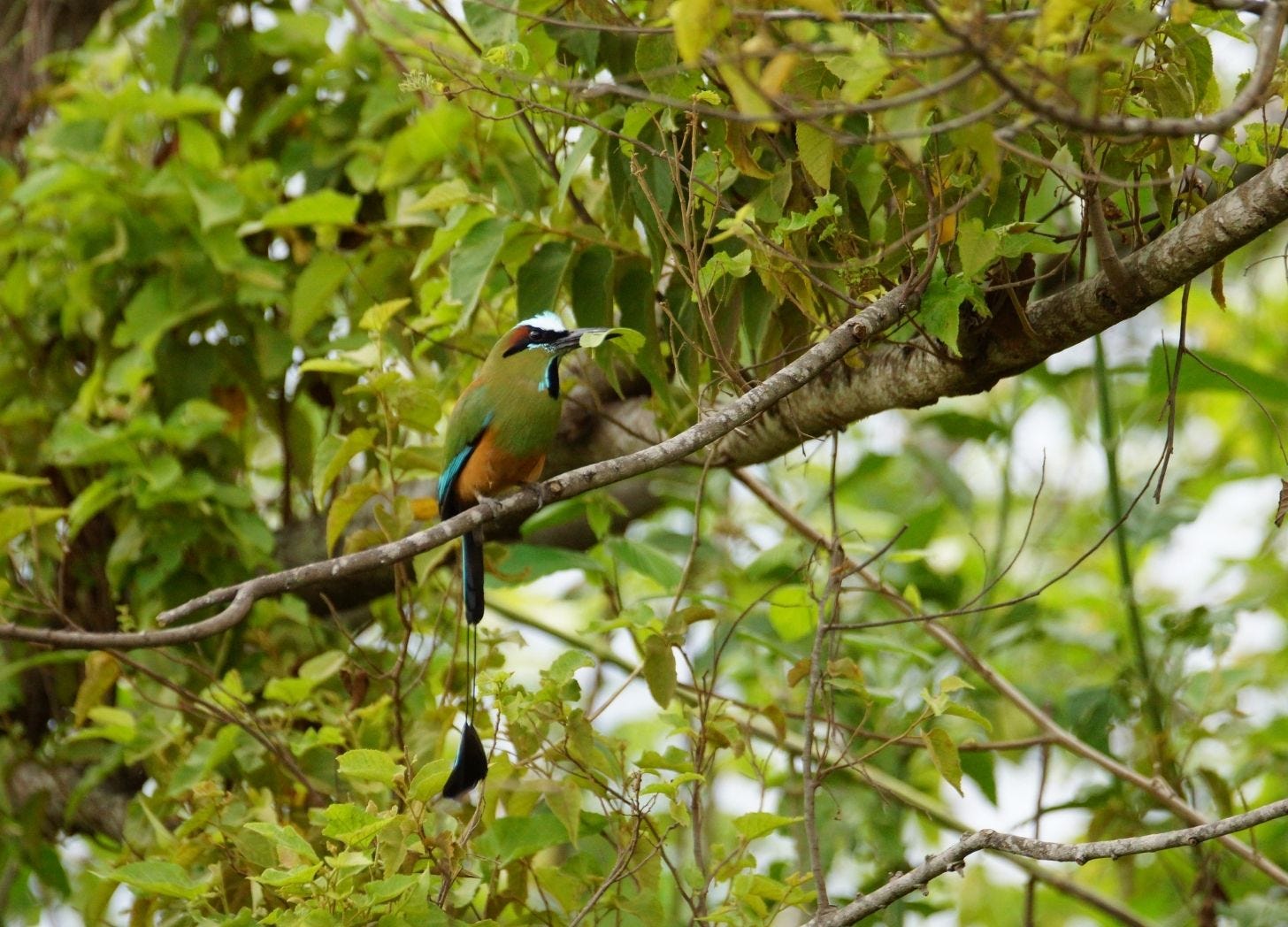
He led us with his own truck deeper into the scrubby jungle to a path. Fresh machete marks on the trees where he had hacked. It was hard to control our excitement when we saw the depression in the ground. A collapse in the earth where the ceiling of the cave had fallen in. We negotiated a rickety stick ladder over fallen rocks. Down to a narrower path of crushed white limestone that stretched across to a crescent cavern opening. A motmot with its blue-green iridescent feathers hooted overhead. Motmots hang out near fresh water, a good sign.
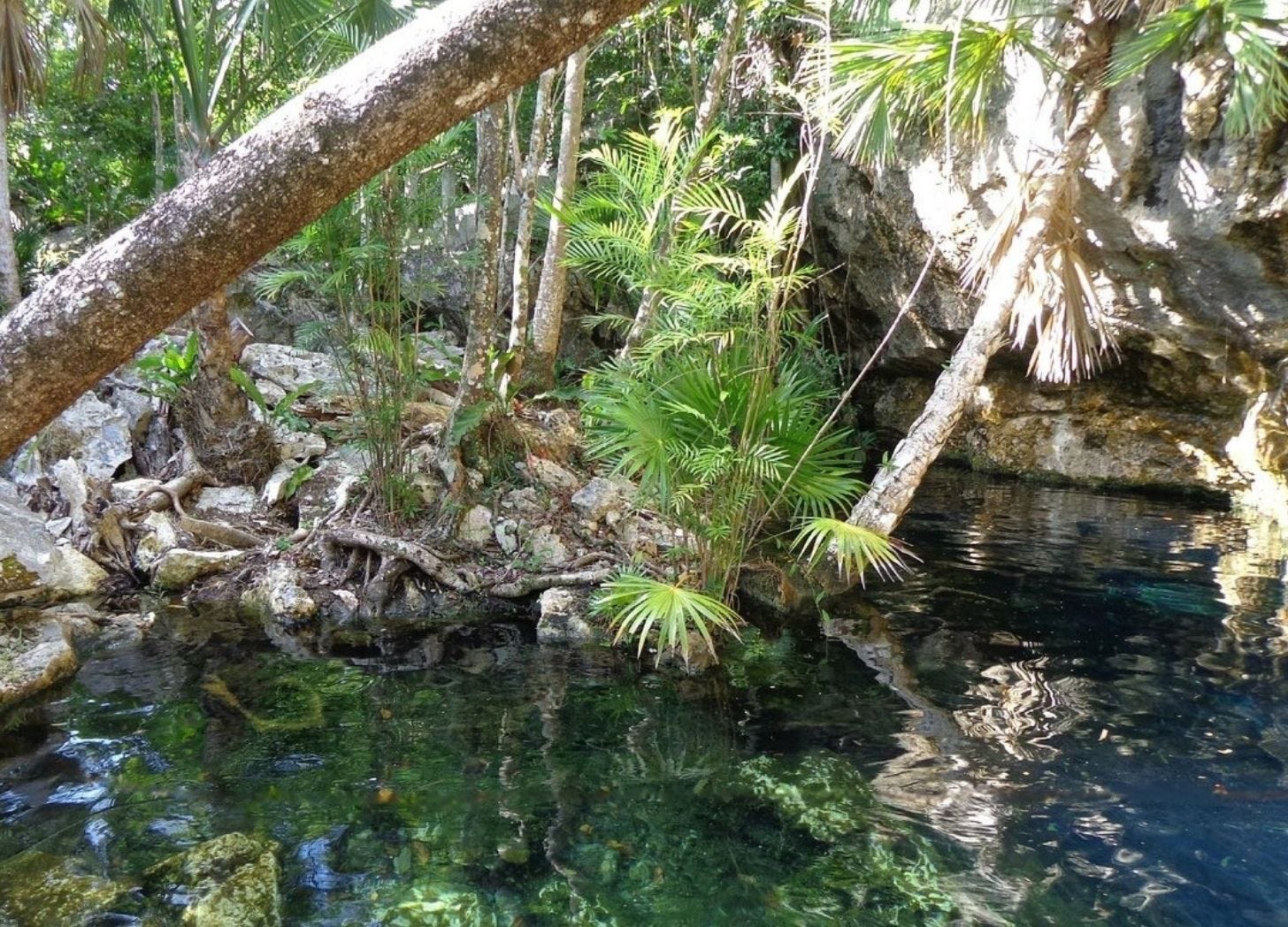
The water was clear, “gin-clear”, as cliche as it sounds, but cave divers would describe it that way. In the cavern, lit up by the sun, we stirred up a little sediment, and watched it float downstream. Another good sign of water flow. And beyond the daylight we could make out the faint darkness of a tunnel opening. The owner told us no one had ever dived it. “Did it look good?” “What did we think?” We could not hide our shit-eating-grins. This was a “glory-hole” We asked if we could return the next day with gear. The 15-minute drive home from the site was banter and theories of where the cave could go.
After coffee the next morning we loaded our tanks into the truck. Usually when we check out a new cenote we take only a single tank, a regulator, mask and fins, planning on only one of us getting into the water. This time we were confident there were going to be passageways to explore so we both loaded full sets of equipment, with a plan that this would be more than a “look and see”.
The owner met us at the entrance again. He watched us haul gear to the water and get into our tanks. Cave diving was uncommon. Locals, especially kids, would love to watch us suit up. Sometimes the kids helped by carrying our fins or a mask. Thrilled. Then we’d disappear for hours at a time and reappear. It would not be a surprise if there was a smiling face waiting for us as we surfaced.
We had explored some other cenotes in the neighborhood and had a sneaking suspicion that this one would connect to the others nearby.
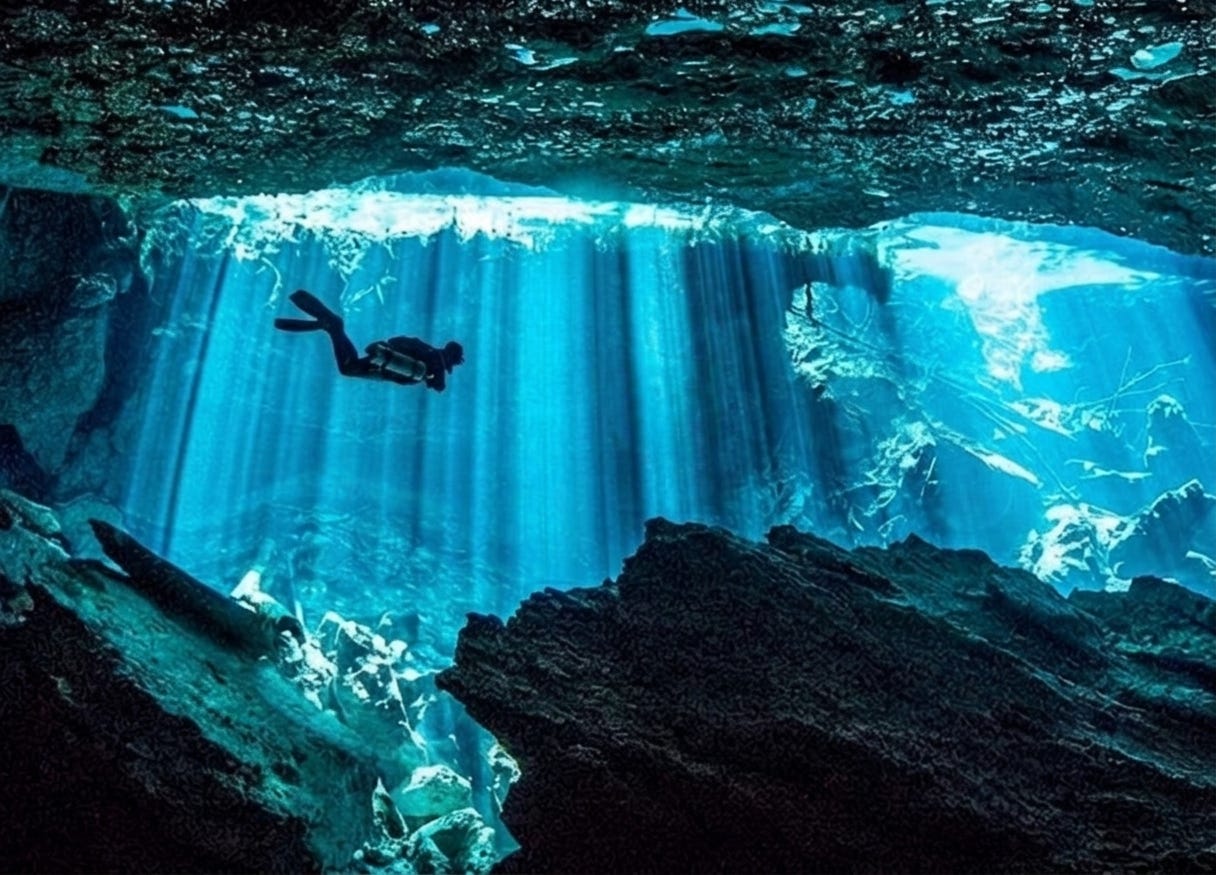
We were the first cave divers into Chac Mool. It was 1997. The system is nine kilometers (five miles) long. We thought it would connect to Ponderosa, otherwise known as Sistema El Eden, a bit down the road. It didn’t.
Downstream, we found the largest underwater stalactite in the world. I saw it first. Gary was ahead, laying line, choosing compass bearings against the surrounding cave maps in his head. Sometimes he was so fixated on the compass it irked me. He did not go off course. Me? I went off it. I wanted to see what was there. We butted heads underwater. Often. Inside a massive room in the cave, darkness ate my halogen light beam. As I panned the room the light hit a stalactite. Startled. It was over my right shoulder. Nothing in any cave I had been in looked like this. I flashed my light to get Gary’s attention. I then pointed my light beam to illuminate my find through the bluish hue of the water. Small flakes of calcite snowing down from the ceiling of the cave from my bubbles. It was an enormous white drip-stone formation. We were near the ceiling. The stalactite hung down 12 meters (42 feet). Shouting cheers of victory through our regulators at the discovery. We named the calcite formation “Xix Ha Tunich”. Mayan for the “Big Water Stone”.
A cave no one knew about. We happened upon it all because I saw a sign on the drive home from a grocery run.
There were seven or eight of us who dove these caves in those years. I was one of a few women. We knew each other’s skills. We had the training, the equipment, and the respect for what could go wrong. My dear friend Harry died in this cave, so I have bitter-sweet memories when I hear the name “Chac Mool”.

That’s how it was then. Ten pesos. A bottle of Coca-Cola. Maybe a small package of cookies won admission. Spanglish with a short guy in chanclas who owned a cenote, could not swim, and hoped he had an attraction people would pay to see.
Chac Mool was one of many spots I explored. You don’t get paid to explore. I did it because I loved it. That was enough. And maybe even the dream to be on the cover of National Geographic. I did make the cover of Dive Girl Magazine though. Among a few others. I made sure my parents got copies. Proof I was not wasting my life. Women’s Diver’s Hall of Fame. Close enough.
We did several exploration dives in Chac Mool, and then guided divers on both cavern and cave dives after. I have not been back in years. My memories of what it was are too good to risk. Today Chac Mool is a dive site. Cave and cavern divers still go. Cameras are not allowed. The photographer charges forty dollars per person in a group. Sixty if you dive alone for pics.
And I am not sure if the owner is still there. So do not show up with a Coca-Cola, cookies and drop my name thinking you can get in.
The caves were the easy part. Everyday life was harder. Start here.


Lunch Alone. A foreigner in a foreign place.

I stood with my lunch tray, looking around the comedor, the employee cafeteria. Scouring the room for a place to sit. Lots of brown eyes looked up to see that same girl with blonde hair and blue eyes, wondering, where she was going to sit. I looked for an empty table where I could hide, eat my tortillas and escape quickly.
FAQs and answers for the curious.
What is a cenote?
A cenote is a natural sinkhole in limestone bedrock that exposes groundwater. The Yucatan is riddled with them. Like Swiss cheese. The Maya considered them sacred. Divers use them as entryways to the underwater cave systems.
What’s the difference between cavern diving and cave diving?
Cavern diving is done within the daylight section of the cave and usually under the supervision of a trained cave diver as a guide. No special equipment is needed to do a cavern dive tour.
Do I need special training to dive in caves?
Yes, cave diving is considered technical diving and requires specialized training and equipment. Message me if you need recommendations of training organizations.
What is “laying line?”
In an unexplored cave we lay a line through the passageway as we go. It does two jobs: it gets us out if visibility drops, and we survey it on the way out to map the cave.
Does the name Chac Mool have a meaning?
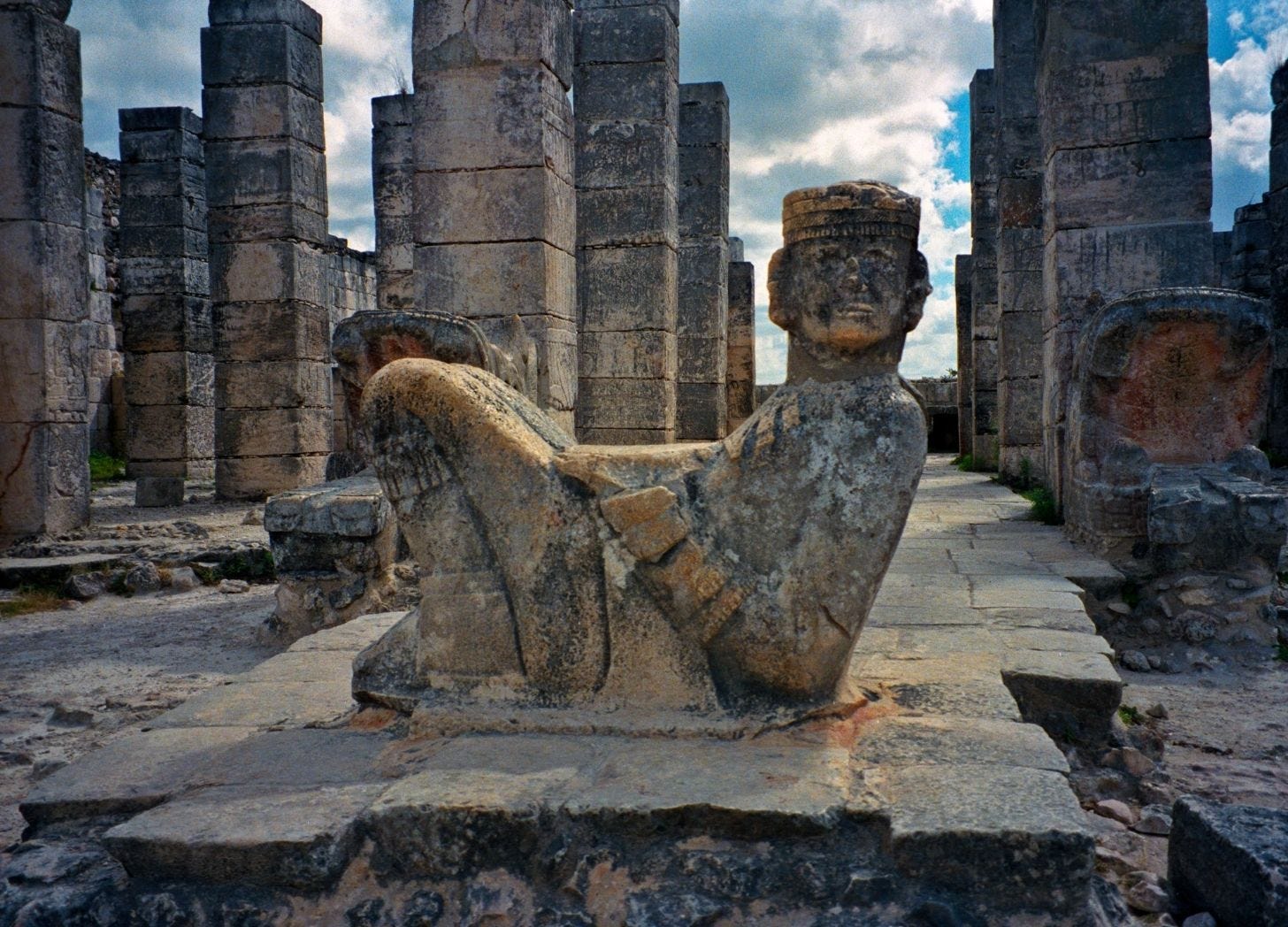
Yes! Augustus Le Plongeon named the reclining statues at Chichen Itza in 1875. Figures on their backs, heads turned, bowls on their stomachs. The name comes from Yucatec Maya, roughly “red jaguar paw”. The statues are associated with Chac, the Mayan rain god. Also spelled Chacmool as one word. Chaac with two a’s is the Mayan language transliteration.
Isn’t glory hole some vulgar term?
Yes, as I understand now the general context of the word. Back then I did not know. It was never said with intent of being lewd. We often used the term when we referred to a promising cave.
I first went to the Riviera Maya back in 1990. We still called it the "Cancun-Tulum Corridor" back then, before the big developers moved in and created the Riviera Maya marketing scheme 10 years later. I stayed at Capitan Lafitte, now called Petite Lafitte, I think, and it was the most laid-back place you ever saw. For some reason, I even stood once at the outdoor palapa bar there in my boxer shorts (possibly because I couldn't find my pants) and got into an argument in Spanish about economics with the bartender. Which was interesting because I barely speak Spanish and know nothing about economics. I don't think the current groovy version of the resort would let you order drinks in your boxers. And then there were the two Austrian nurses that I took for a ride into the jungle in my rented Jeep only to find, during an intense tropical downpour at about four in the afternoon, that the "convertible" roof didn't actually close, so we stopped in a bodega on a dirt road to get out of the rain, bought some beers, and danced among the rice sacks and crates of canned goods to mariachi music from the clerk's transistor radio. You bring back such wonderful memories of a time gone by. A time we will never see again. (Jeez, I could probably get a Substack column out of this!!)
Spanglish has given us some amazing experiences too. ☺