


The faster road was twenty minutes shorter. He took us the long way.
“I prefer to go in at the seaside road,” Stefanos said, “to see the place where I give the ring.”
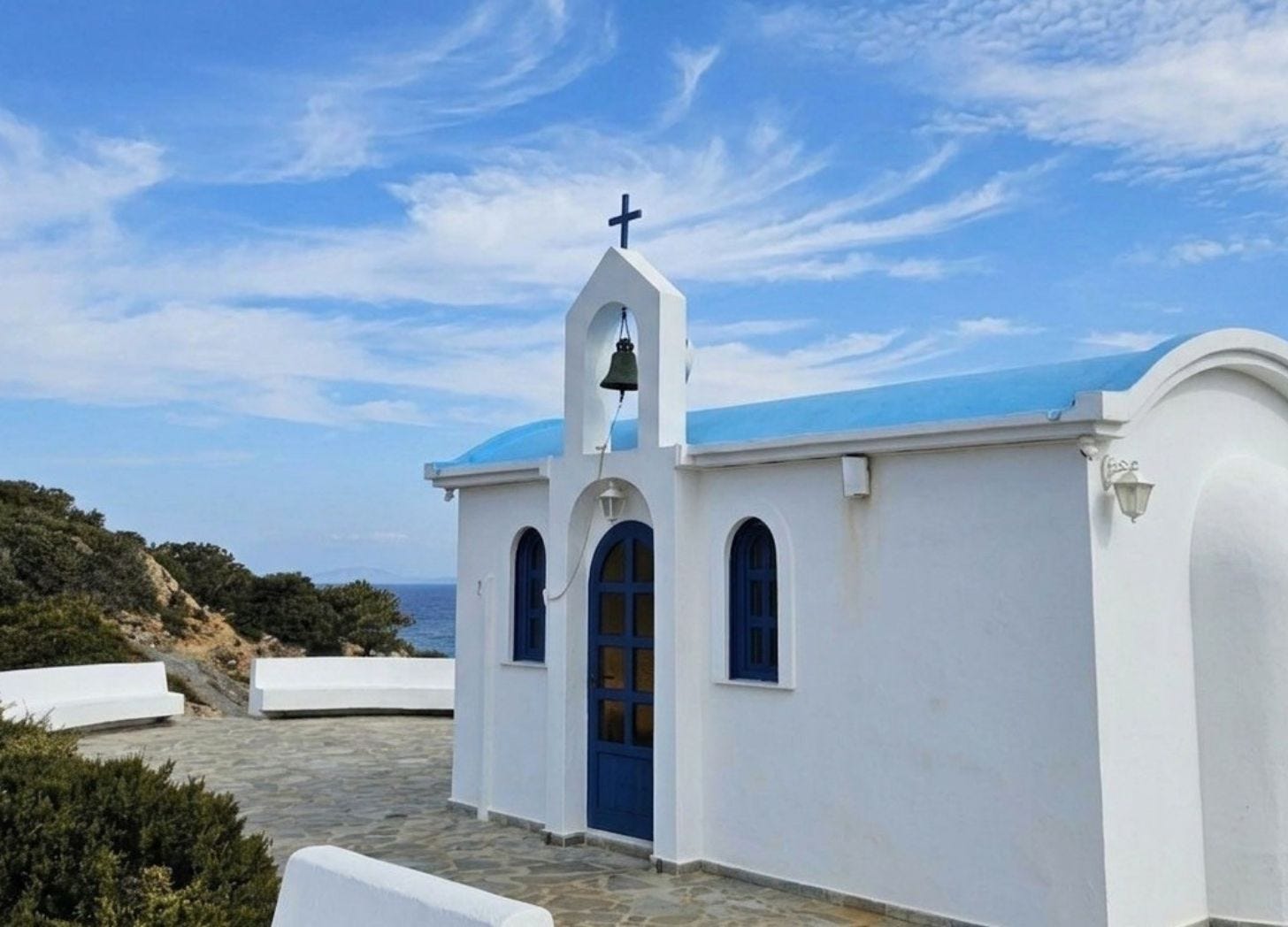
It was a small chapel above the sea in the settlement of Aeolos. “Panagia Katafygiotissa” on Katafygi Bay. The walls were painted by a man named Dimitris Mytaras, whose name I had not heard. But then again why would I. I knew nothing about Greece. Stefanos asked what we cared about and then he built our day together from that.
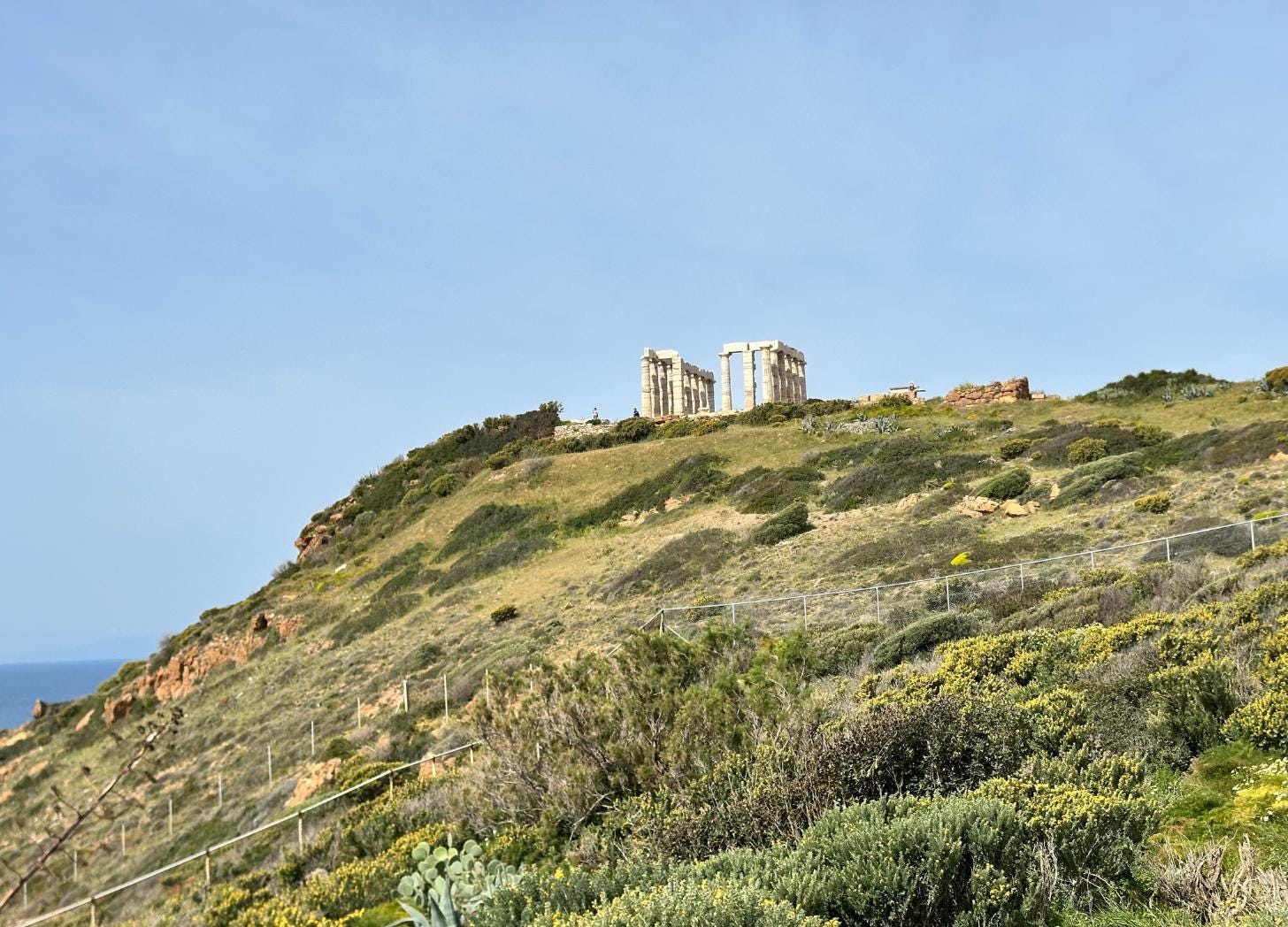
The only place my sister and I wanted to see, the must see, was the Temple of Poseidon. That was the whole list.
The white-washed chapel was not on any list. It was his. It was the place he proposed to his wife. He could only get in because friends lived in the village.
Mexico’s Riviera Maya, from 1992, with a boyfriend and two trucks of dive gear and $7000 USD. I know what it costs to give a stranger your day, your knowledge, your country. I know what gets traded when the price is money. And I know what the years do to the people who keep giving it away honestly.
A friend gave me his name before I flew over. She is American and Greek, and she hires Stefanos every time she lands in Athens.
He kept talking.
He had been talking all morning. The way someone talks who has things he wants you to know about the place he lives in, and about himself, because he can’t separate the two.
His daughter was nine. His wife was from Crete and owned a beauty salon in the neighborhood we drove through. He worked from before sunrise to past midnight, some days to two in the morning when the overnight flights came in.
Those are long-ass days.
But that’s high season anywhere. You work when there’s work.
He was not from Athens. Paros was home, his parents still there. He flies back often. The car comes by ferry. The long boat ride he can’t stand. One small island is his favorite though, and not a famous one. Schinoussa. Down past Naxos. Tiny, 229 people. The water he could not describe was that beautiful.
Taste tsipouro, not ouzo, he said. Ouzo gives you nothing but a headache. (Yes, I knew that from personal experience.) The best wine in Greece was Malagouzia. Then he spoke of a motorbike accident in 2010, the one that made him pray and keep praying. He went to church every Sunday now.
All day he showed us places and how to see them without the admission price or the queue. The back way to ruins and the photograph no one else had found.
Then he pulled the car over. “Get out,” he said, “I will stay with the car. Go watch, it’s very traditional.” It was a changing of the guard at the president's residence, on a side street, no crowd, just a handful of people.
We stood a few feet from the ceremony. A tour bus would never travel this side street. A regular taxi would have driven straight past, but not him.
At the Temple of Poseidon he told how the sea got its name. Aegeus's son Theseus went to Crete to kill the monster Minotaur. He promised his father he would come back under white sails if he lived. Theseus killed Minotaur, got drunk on the way home and forgot to change the sails. Aegeus saw black sails. He threw himself off the cliffs. That is the Aegean Sea.
Then, without changing tone, he said the average salary in Greece was 880 euros ($1020 USD) a month. Before the crisis, in 2004, 2005, if you didn't have coffee in your house you went next door and the neighbor gave you coffee. Now if you knock, the neighbor won’t open the door. He said it the same way he said his daughter was nine. The same way he said Malagouzia.
I knew this. I had told a version of it myself, in Mexico, by the end. The pressure of tourism shows up first in the smallest gestures, the ones that used to be free. But it shows up second in something harder to put your finger on: the willingness to give a stranger the inside of your life. He was still handing it over. He was driving us along the seaside instead of the highway so he could show us where he gave his wife the ring. He was nine years into the job and he had not yet learned to stop.
I can say this because I did the same thing. I whored out my whole life for the business, for the customers. It helped. The business worked. Was the price worth it, I still wonder. So I knew what I was watching when I watched him. I had been him.
But then he gave me what I used to give my guests. The day. The stories. The thing you cannot buy because it was never for sale. I had spent a career handing it to strangers. Now a stranger handed it back to me. The friends I made were never an accident. They were the selfish reason I kept going.
I should be honest. I am glad I went to Athens. I do not need to go back. Maybe I am too much of an outdoors or small town girl. It was congested and the noise did not stop.
The graffiti was everywhere. He drove through all of it. He still handed us his story. His daughter, his island, his wife’s ring, his Sunday church, his favorite wine. The city was wearing him down. He had not let it take the work.
He told me about the cruise ships. Three, four a day into Piraeus now. Two thousand people at a time. They walk off the boat for a few hours and walk back on. They do not sleep on the island. They do not eat a meal there. “They buy only one salad, and one ice cream, and one souvenir,” he said. “Only that.”
You cannot see a place that way, he said. You want minimum two days. One island, one place, something. I had one day. He told me you need two. The next morning I flew to Santorini like everyone else. He gave me a full day. I was already leaving.
On the catamaran to Santorini the next day, a woman named Helen worked the deck. I asked her what visitors don't see in Greece.
"Understand why we look sometimes little tired," she said. The person who brings your drink, who says hello, you see only that. You don't see the rest. "It's too pressure behind this."
But that was Santorini, the next day. Back in Athens, the driver still had hours to go.
His daughter was sick. The nine-year-old. She was home waiting for him to take her to the doctor while he drove us through Athens. He mentioned it once and kept driving. My sister and I both insisted he drop us off early and go take care of her.
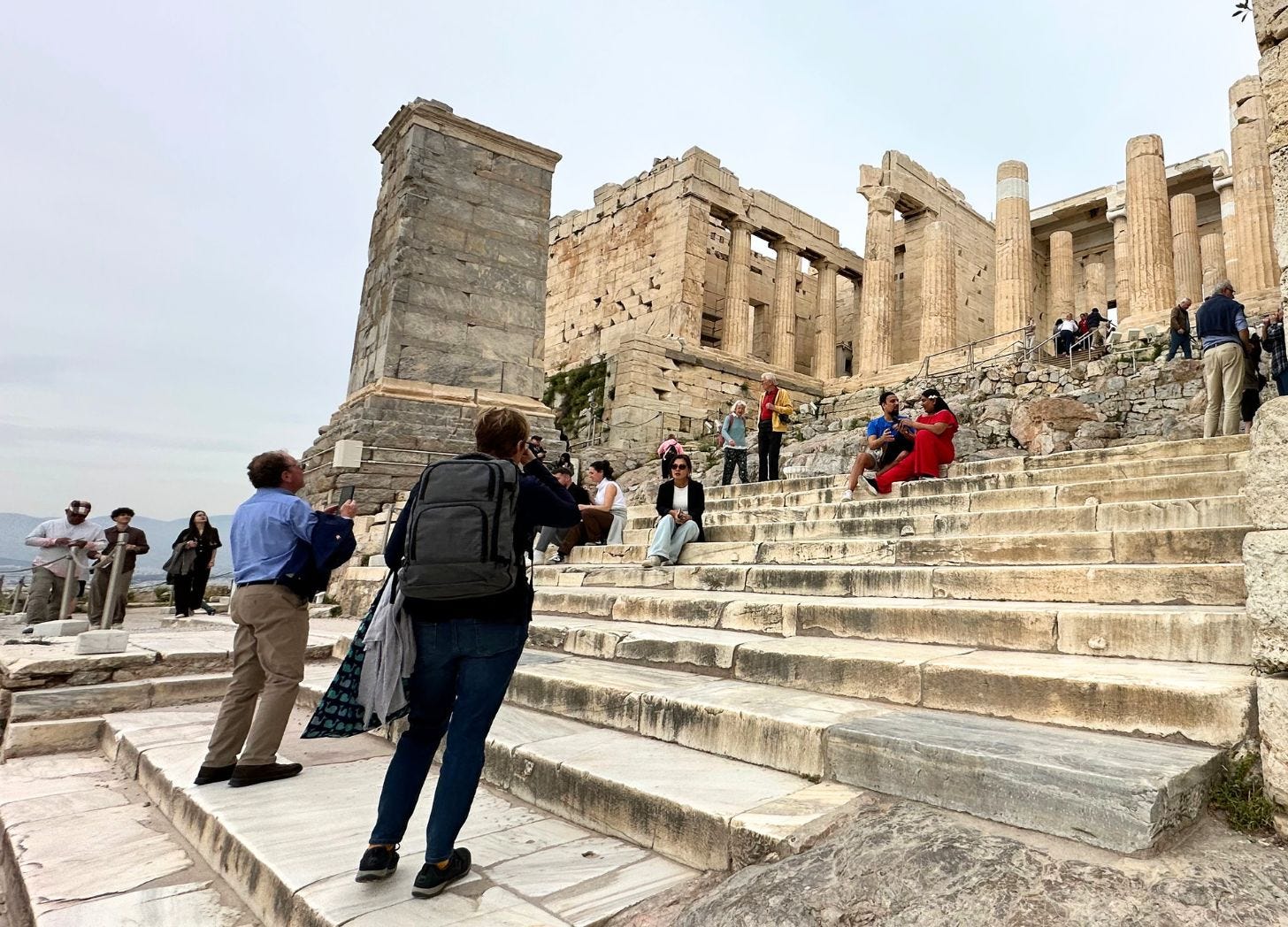
He bought us souvenirs. He paid for them out of his own pocket, small things, before he left us at the Acropolis. A sick child waiting at home, the 880-euro month most Greeks live on, and he bought us souvenirs.
Then he came back. After we had walked the hill and seen the marble, he came back for us at the end of the day. The last thing he did was make us promise. “Do not take a taxi off the street, they cannot be trusted”.
This is how Stefanos lives. One person trusts him and hands him the next. My friend, then me, then whoever I tell. The cruise ship needs none of it. It does not need his name, it does not need to trust him, and it never comes back. Two thousand people, a salad, an ice cream, gone by dark.
I spent 27 years building the same thing he has, one guest at a time. Trust you cannot put on a brochure. It does not scale. It was never meant to.
That is what is worth flying for. Not the view. The man who takes the long way to show you where he gave his wife the ring.
If something I wrote made you think, laugh, or feel like someone finally said the thing — buy me a glass of Malagouzia wine. It keeps me something to sip after a long day of writing.
Pucker Up: A Town Built on Lemons

Menton, France is known for lemons. Lemon soap, lemon tea towels, lemon-print dresses, lemon sorbet, limoncello, and lemon tarts in every café window.
Enjoyed reading your take on Athens Kay! Glad you saw some sights the average tourist never gets to see!
With tear filled eyes, I read your story with subtle reminders of that feeling. You only know it when you've survived it. Thank you for the story of the humans - the ones who leave the mark - not the places, the technology, the food. While all valuable, it's the people with whom we interact that can leave that tiny imprint in our soul. I hope he catches his break, his breath, one day and receives all the good the universe has to share with him <3